Abstract
Objective: To examine the independent and interacting effects of perceptual salience and task load on executive vigilance performance, as well as whether these factors modulate the vigilance decrement over time.
Background: Hits in vigilance tasks typically decline with time-on-task. This decrement is explained by the resource depletion of attentional resources (overload model) or to disengagement caused by task-unrelated thoughts (underload model). Previous research manipulated salience or task load separately, yielding inconsistent findings. Moreover, few studies have examined both factors simultaneously while holding other task parameters constant.
Method: Two preregistered studies and a pooled data analysis were conducted using the ANTI-Vea task, which assesses attention and vigilance components. In Study 1 (N = 84), perceptual salience of the target stimulus was manipulated between participants. In Study 2 (N = 45), perceptual salience and task load were orthogonally manipulated within participants. Study 3 reanalyzed combined data (N = 238) from Studies 1 and 2 together with data from previous research.
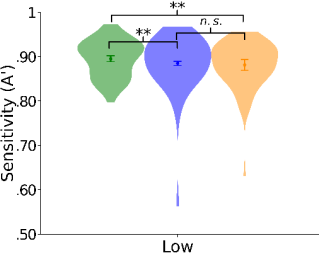
Results: Executive vigilance showed significant effects of perceptual salience and task load, with larger overall accuracy observed for the most salient targets and under moderate task load (dual-task condition). In signal detection measures, A′ was largest for the most salient targets, whereas moderate task load was associated with a less conservative response bias (B′′). However, neither variable modulated the observed vigilance decrement over time.
Conclusion: Perceptual salience and task load affect overall executive vigilance but do not modulate its decrement over time-on-task.
Application: Findings may inform the design of tasks and systems that optimize vigilance by promoting an optimal balance of task demands, by considering perceptual salience and task load to minimize failures and reduce the risk of vigilance decrement-related accidents.