Abstract
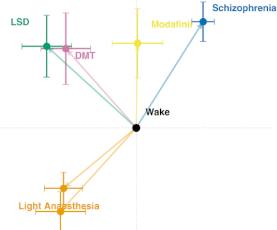
A general account of how diverse states of consciousness arise from brain activity requires a quantitative framework that generalises across them. The Entropic Brain Theory proposes that states of consciousness can be ordered along a single dimension defined by the entropy of spontaneous neural activity, but this prediction has not been tested across pharmacological and clinical perturbations within a common analytical pipeline. Here we quantify the temporal irregularity of time-resolved small-world topology using sample entropy, applying the same pipeline to pharmacological (psychedelics, modafinil, propofol anaesthesia) and clinical (schizophrenia) fMRI datasets. Propofol anaesthesia occupied the low-entropy end of the axis; psychedelic states and schizophrenia occupied the high end. The ordering tracks combined modulations of the level and content of consciousness, ranging from reduced awareness under anaesthesia to the heightened arousal and expanded experience of psychedelic states and the disorganised, dysregulated processing of schizophrenia. Crucially, this result was not reducible to fluctuations in mean functional connectivity, and was supported by convergent reorganisation of higher-order association cortex under psychedelics and anaesthesia, alongside a distributed loss of network specificity in schizophrenia. These findings provide cross-condition empirical support for an entropic continuum of brain states and identify the temporal diversity of large-scale network reconfiguration as a primary axis of conscious dynamics.